


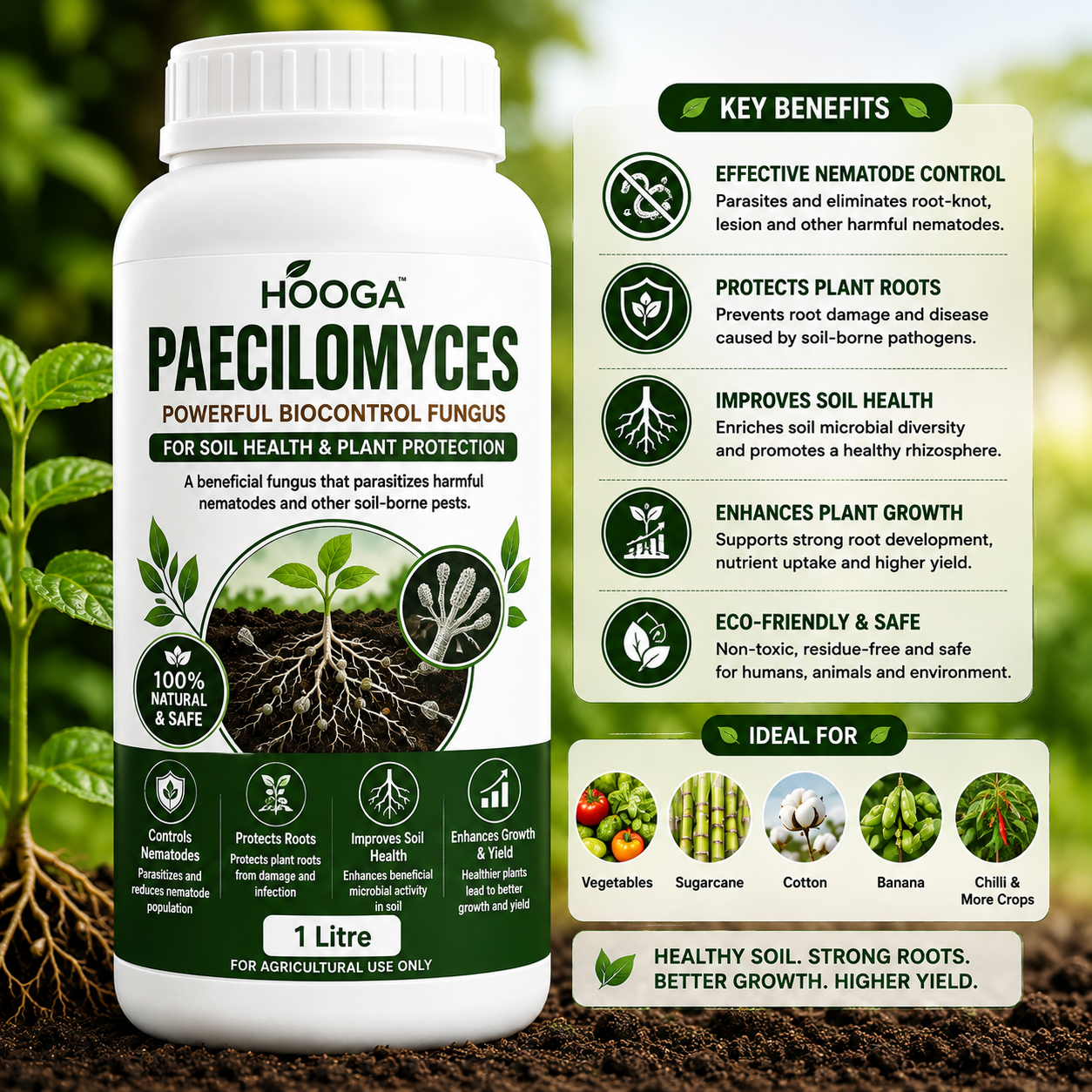
Paecilomyces 1 Litre | Bio-Nematicide for Root-Knot Nematodes | HOOGA Seeds
Paecilomyces 1 Litre | Bio-Nematicide for Root-Knot Nematodes | HOOGA Seeds
Quantity: 1 Litre
Paecilomyces establishes itself in the soil and root-zone environment under suitable conditions.
The fungus can interact with susceptible nematode stages and parasitize them. Research and ICAR documentation report activity against nematode eggs, egg masses and females, making Paecilomyces particularly useful in biological nematode-management programs.
This biological mode of action makes Paecilomyces a valuable tool for farmers looking to reduce dependence on conventional nematode-management methods.
Paecilomyces for Root-Knot Nematodes
Root-knot nematodes (Meloidogyne spp.) are important plant-parasitic nematodes that attack plant roots.
Nematode-affected plants may show:
- Root galls or knots
- Poor root development
- Reduced plant vigour
- Yellowing or nutrient-deficiency-like symptoms
- Stunted growth
- Uneven crop development
- Reduced nutrient and water uptake
Paecilomyces can be incorporated into an integrated approach for managing root-knot nematode pressure.
ICAR research has investigated Paecilomyces lilacinus against Meloidogyne incognita in crops including tomato and capsicum.
Description
Paecilomyces 1 Litre – Biological Nematode Control for Healthy Roots
Buy Paecilomyces 1 Litre online from HOOGA Seeds – a beneficial biological fungus used for the management of plant-parasitic nematodes and root-zone pests. Paecilomyces, particularly Paecilomyces lilacinus (now classified as Purpureocillium lilacinum), is a well-known nematophagous fungus used in biological nematode management.
ICAR-IIHR describes Paecilomyces lilacinus as a bio-nematicide useful for managing root-knot nematodes, reniform nematodes and citrus nematodes.
If you are looking for Paecilomyces bio-nematicide, Paecilomyces lilacinus, biological nematode control, root-knot nematode control or bio-nematicide for plants, HOOGA Seeds Paecilomyces is an excellent microbial solution to include in an integrated crop and soil-management program.
Key Benefits of Paecilomyces
- Helps in the biological management of plant-parasitic nematodes
- Particularly useful against root-knot nematodes
- Can act against susceptible nematode eggs and other stages
- Supports biological management of nematodes in the soil and root zone
- Helps protect the root environment from nematode pressure
- Useful as part of Integrated Pest Management (IPM)
- Suitable for sustainable and biological farming practices
- Useful for agricultural and horticultural crops
- Can complement other integrated soil and nematode-management practices
ICAR research has documented P. lilacinum activity against nematode eggs and root-knot nematodes, while ICAR-IIHR lists it as a bio-nematicide for root-knot, reniform and citrus nematodes.
What is Paecilomyces?
Paecilomyces lilacinus is the older scientific name commonly used for a beneficial fungus that is now classified as Purpureocillium lilacinum.
It is a nematophagous fungus, meaning it can parasitize certain plant-parasitic nematodes. The fungus is particularly known for its ability to interact with nematode eggs and other susceptible stages.
ICAR has identified Purpureocillium lilacinum (= Paecilomyces lilacinus) as a microbial biocontrol agent for nematode management.
How Does Paecilomyces Work?
Paecilomyces establishes itself in the soil and root-zone environment under suitable conditions.
The fungus can interact with susceptible nematode stages and parasitize them. Research and ICAR documentation report activity against nematode eggs, egg masses and females, making Paecilomyces particularly useful in biological nematode-management programs.
This biological mode of action makes Paecilomyces a valuable tool for farmers looking to reduce dependence on conventional nematode-management methods.
Paecilomyces for Root-Knot Nematodes
Root-knot nematodes (Meloidogyne spp.) are important plant-parasitic nematodes that attack plant roots.
Nematode-affected plants may show:
- Root galls or knots
- Poor root development
- Reduced plant vigour
- Yellowing or nutrient-deficiency-like symptoms
- Stunted growth
- Uneven crop development
- Reduced nutrient and water uptake
Paecilomyces can be incorporated into an integrated approach for managing root-knot nematode pressure.
ICAR research has investigated Paecilomyces lilacinus against Meloidogyne incognita in crops including tomato and capsicum.
Paecilomyces for Agriculture
Paecilomyces is particularly useful for growers interested in:
- Biological nematode control
- Bio-nematicides
- Root-knot nematode management
- Soil biological management
- Sustainable agriculture
- Organic farming inputs
- Natural farming
- Integrated pest management
- Microbial crop protection
Crops
Depending on the formulation, strain and product label, Paecilomyces-based products may be used in management programs involving:
- Tomato
- Brinjal
- Chilli
- Capsicum
- Okra
- Cucumber
- Carrot
- Banana
- Citrus
- Coconut
- Guava
- Fruit crops
- Vegetable crops
- Flower crops
- Nursery plants
- Other horticultural crops
ICAR documentation includes applications involving crops such as brinjal, tomato, carrot and okra, while ICAR-IIHR identifies Paecilomyces as useful for root-knot, reniform and citrus nematode management.
Always follow the crop, target nematode, dosage and application instructions on the specific product label.
How to Use Paecilomyces
Application depends on the product’s formulation, microbial concentration, target nematode and crop.
Depending on the specific formulation, application may include:
Soil Application
Apply around the plant root zone according to the recommended product dosage.
Root-Zone Drench
Certain liquid formulations may be applied around the base of plants to reach the root zone.
Drip Irrigation
Some formulations may be suitable for application through drip irrigation where specifically recommended.
Transplanting Application
For suitable registered products, application may be made around the root zone during transplanting.
A PPQS-registered Paecilomyces lilacinus formulation, for example, specifies soil application through drip irrigation or application around the base of plants, with repeat application according to its registered label.
Do not copy dosage recommendations from another Paecilomyces product. Always use the dosage printed on the HOOGA Seeds product label.
Why Choose HOOGA Seeds Paecilomyces?
HOOGA Seeds provides biological and sustainable agricultural inputs for farmers, gardeners, nurseries and home growers.
HOOGA Seeds Paecilomyces 1 Litre is designed for growers who want to incorporate a biological approach to nematode and root-zone management.
Buy Paecilomyces Online in India
Looking for Paecilomyces online, Paecilomyces lilacinus, Purpureocillium lilacinum, bio-nematicide, or biological root-knot nematode control?
Order Paecilomyces 1 Litre from HOOGA Seeds and add biological nematode management to your crop protection and soil-health program.
Frequently Asked Questions
What is Paecilomyces?
Paecilomyces is a group of fungi. In agricultural biological control, Paecilomyces lilacinus, now classified as Purpureocillium lilacinum, is widely known for biological management of plant-parasitic nematodes.
What is Paecilomyces lilacinus used for?
Paecilomyces lilacinus is used as a biological control agent for plant-parasitic nematodes, particularly root-knot nematodes. ICAR-IIHR also identifies its usefulness against reniform and citrus nematodes.
Is Paecilomyces a bio-nematicide?
Paecilomyces-based formulations can be used as biological nematode-control products. The exact legal classification, formulation and approved claims depend on the particular registered product.
Does Paecilomyces control root-knot nematodes?
Purpureocillium lilacinum has documented activity against root-knot nematodes, including Meloidogyne species. ICAR has reported its ability to parasitize nematode eggs and suppress egg hatching.
What is the difference between Paecilomyces lilacinus and Purpureocillium lilacinum?
Purpureocillium lilacinum is the current scientific classification, while Paecilomyces lilacinus is the older name. Both names are important to include on an SEO product page because farmers may search using either term.
Can Paecilomyces be used for vegetables?
Paecilomyces has been studied and used in biological management programs involving horticultural and vegetable crops. The appropriate crop and dosage depend on the specific formulation and label.
Can Paecilomyces be used for tomato?
Paecilomyces has been studied for biological management of Meloidogyne incognita affecting tomato.
Can Paecilomyces be used in organic farming?
Paecilomyces is a biological microbial agent and may be useful in sustainable and organic farming systems. Certified organic growers should confirm that the particular product is permitted under their certification requirements.
Additional information
| Weight | 0.1250 kg |
|---|---|
| Dimensions | 30 × 25 × 30 cm |
Related products








Reviews
There are no reviews yet.