


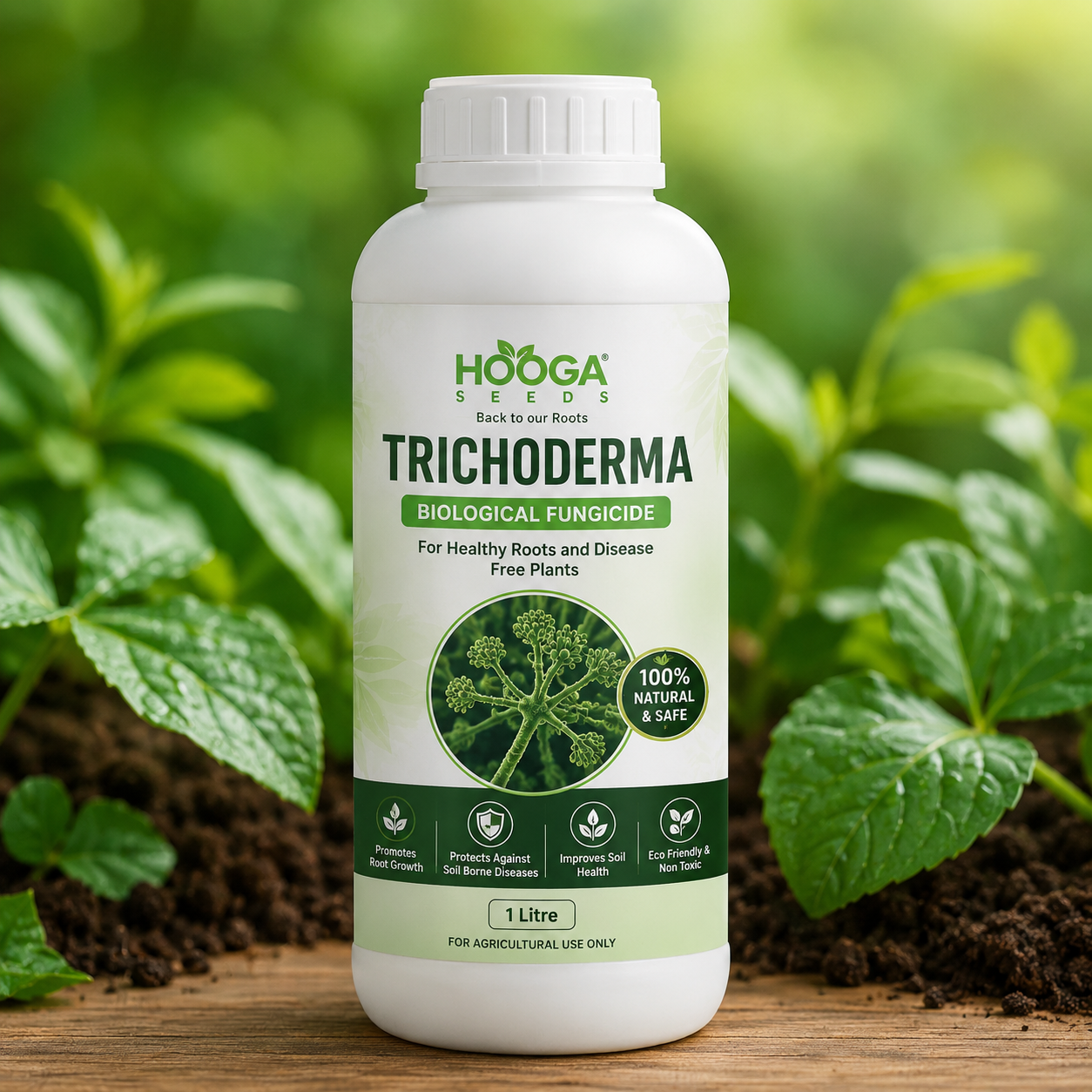
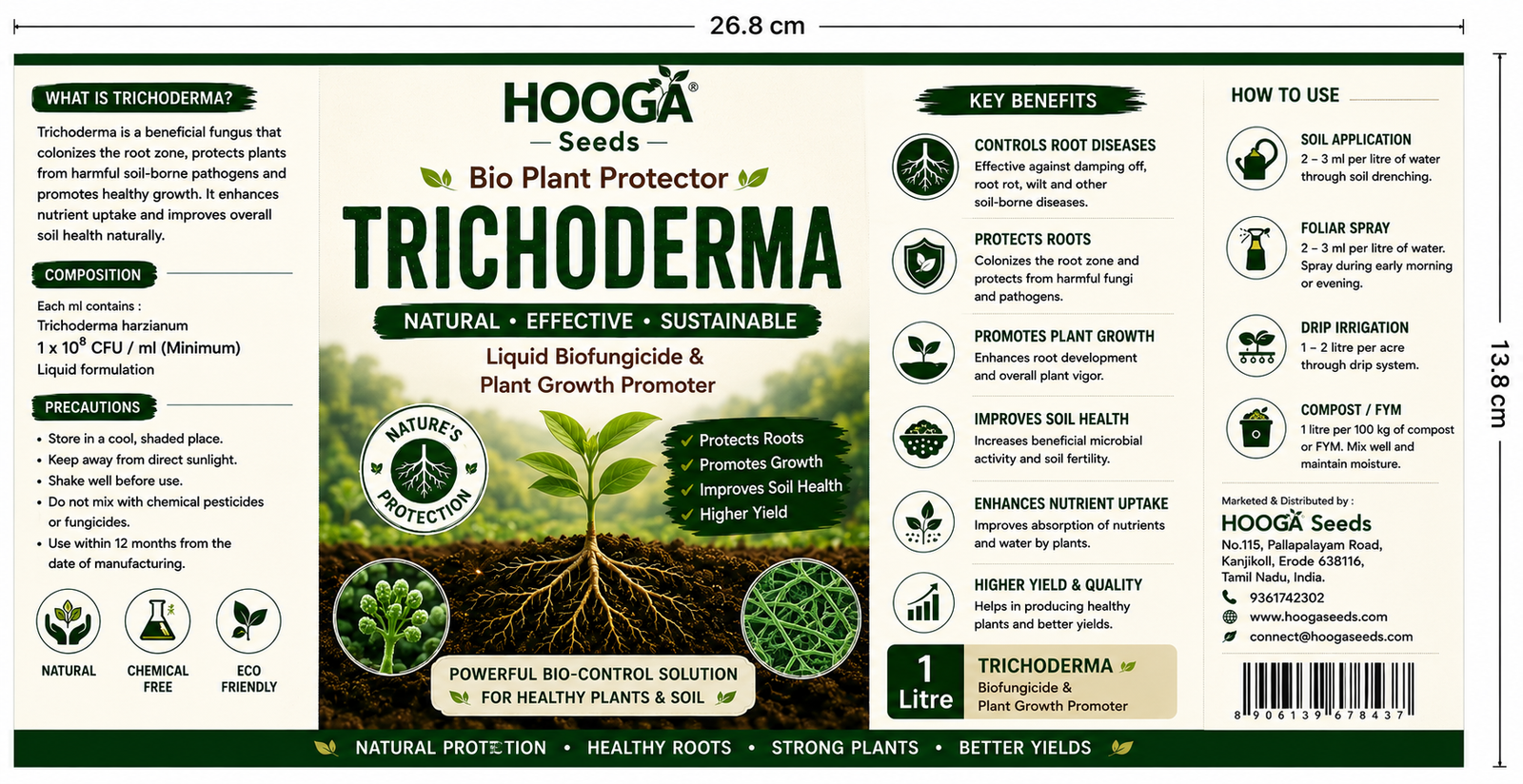
Trichoderma 1 Litre | Biological Fungicide & Soil Health Biofertilizer – HOOGA Seeds
Trichoderma 1 Litre | Biological Fungicide & Soil Health Biofertilizer – HOOGA Seeds
Quantity: 1 Litre
Beneficial fungal bio-input for root-zone health, soil biological activity and integrated management of soil-borne plant pathogens. Trichoderma is a group of beneficial fungi used in agriculture as biological agents for supporting plant health and managing certain soil-borne pathogens.
Buy Trichoderma 1 Litre online from HOOGA Seeds.
Description
Trichoderma 1 Litre | Biological Fungicide & Soil Health Biofertilizer – HOOGA Seeds
Trichoderma 1 Litre – Beneficial Fungal Bio-Control & Soil Health Solution
Trichoderma Biofertilizer / Biofungicide for Healthy Roots, Soil & Plants
Give your plants biological support from the soil up with HOOGA Seeds Trichoderma 1 Litre — a microbial agricultural input designed to support healthy root zones, soil biological activity and integrated management of soil-borne plant pathogens.
Trichoderma is a beneficial fungus widely used in agriculture and horticulture as a biological control agent. It can colonize the root zone and compete with or suppress certain harmful soil-borne fungi, making it an important component of integrated crop and soil management.
Whether you are a farmer, organic grower, home gardener, terrace gardener, nursery grower or kitchen-garden enthusiast, HOOGA Seeds Trichoderma can be incorporated into an appropriate soil-health and plant-protection program.
🌱 Healthy Soil • Strong Roots • Better Plant Establishment
What Is Trichoderma?
Trichoderma is a naturally occurring group of beneficial fungi found in many soils.
Certain Trichoderma strains are used in agriculture because of their ability to interact with plant roots and the surrounding soil ecosystem. They can compete with harmful microorganisms and are used in biological crop-protection programs.
Research and agricultural recommendations have documented Trichoderma use against several soil-borne pathogens, including Rhizoctonia, Pythium, Fusarium and Phytophthora, depending on the strain, crop and application method.
Why Use Trichoderma in Your Farm or Garden?
🌱 1. Supports Healthy Root Zones
A healthy root zone is the foundation of healthy plant growth.
Trichoderma can colonize areas around plant roots and contribute to a biologically active rhizosphere.
🛡️ 2. Biological Support Against Soil-Borne Pathogens
Trichoderma is widely used as a biological control agent for the management of certain soil-borne fungal pathogens.
It can compete with and suppress susceptible harmful fungi under appropriate conditions.
🌿 3. Supports Plant Establishment
Healthy roots are particularly important during seed germination, nursery growth and transplanting.
Introducing beneficial microorganisms into the root zone can form part of an integrated approach to helping young plants establish successfully.
🌱 4. Supports Root Development
Certain Trichoderma strains are associated with plant-growth-promoting effects and improved root development.
A stronger and healthier root system can help plants make better use of the available growing environment.
♻️ 5. Supports Soil Biological Activity
Trichoderma contributes to the biological community around plant roots and can complement good soil-management practices.
Use it alongside:
- Compost
- Farmyard manure
- Vermicompost
- Organic matter
- Mulching
- Balanced plant nutrition
- Good irrigation
- Proper drainage
🌾 6. Useful in Integrated Crop Management
Trichoderma can be incorporated into Integrated Pest Management (IPM) and integrated soil-health programs.
It should not be viewed as a replacement for every other plant-protection measure. Crop sanitation, suitable varieties, drainage, irrigation management and other recommended practices remain important.
Trichoderma for Soil-Borne Diseases
One of the major reasons farmers use Trichoderma is its role in managing certain soil-borne fungal pathogens.
TNAU identifies Trichoderma species as useful biological agents against pathogens including Rhizoctonia solani and Pythium, while ICAR research and technologies document Trichoderma use against pathogens such as Fusarium, Rhizoctonia, Pythium and Phytophthora.
Commonly associated soil-borne problems include:
- Fusarium-related diseases
- Rhizoctonia-related diseases
- Pythium-related diseases
- Phytophthora-related diseases
- Certain root and soil-borne fungal problems
Important: Effectiveness depends on the Trichoderma species/strain, crop, pathogen, soil conditions, application method and product quality. Do not assume that every Trichoderma formulation controls every disease.
How Does Trichoderma Work?
Trichoderma can support plants through several biological mechanisms.
1. Root-Zone Colonization
The beneficial fungus establishes around suitable plant roots.
2. Competition
Trichoderma can compete with harmful microorganisms for space and available resources.
3. Biological Antagonism
Certain Trichoderma strains can inhibit or suppress susceptible plant pathogens through biological interactions.
4. Root Association
Some strains can interact positively with plants and support root development and plant growth.
5. Healthier Rhizosphere
Together, these interactions can contribute to a more biologically active root environment.
Trichoderma for Vegetables
Trichoderma is particularly useful to consider in vegetable production where root-zone health and soil-borne diseases are important.
Suitable crop programs may include:
🥒 Cucumber
🍅 Tomato
🌶️ Chilli
🍆 Brinjal
🌱 Okra
🥬 Cabbage
🥦 Cauliflower
🧅 Onion
🎃 Gourds
🥕 Root vegetables
🌿 Leafy vegetables
Use according to the crop-specific product recommendation and label instructions.
Trichoderma for Fruit Plants
Trichoderma-based biological products are also used in horticultural crop management.
They may be incorporated into appropriate programs for:
- Banana
- Mango
- Guava
- Papaya
- Citrus
- Pomegranate
- Grapes
- Sapota
- Other suitable fruit crops
ICAR documentation includes Trichoderma-based technologies for horticultural crops including banana, grapes, guava, papaya, tomato, brinjal and several other crops.
Trichoderma for Nursery Plants & Seedlings
Young plants are particularly dependent on a healthy root environment.
Trichoderma can be incorporated into nursery and transplanting programs through suitable seed, substrate or soil applications, depending on the formulation.
ICAR documents Trichoderma formulations used through seed treatment, substrate treatment and soil application.
This makes Trichoderma a useful biological input to consider for:
- Vegetable nurseries
- Fruit seedlings
- Flower seedlings
- Plantation seedlings
- Transplants
- Potting media
Trichoderma for Home Gardens & Grow Bags
You don’t need acres of farmland to care about soil biology.
HOOGA Seeds Trichoderma can be incorporated into appropriate gardening practices for:
🏡 Home Gardens
Support the biological health of your vegetable-growing soil.
🌿 Terrace Gardens
Useful as part of a root-zone management program for container-grown plants.
🪴 Grow Bags
Can be incorporated into suitable growing-media management practices.
🌱 Nursery Pots
Useful for appropriate seedling and transplant programs.
Trichoderma for Organic & Sustainable Farming
Trichoderma is particularly relevant to growers interested in biological crop protection and sustainable agriculture.
TNAU describes Trichoderma as an eco-friendly biological option and notes its use alongside organic manure.
For best results, integrate Trichoderma with:
Healthy Soil + Organic Matter + Good Drainage + Balanced Nutrition + Crop Rotation + Sanitation + Biological Inputs
This integrated approach is more reliable than depending on a single product.
How to Use Trichoderma
The correct application rate depends on the specific Trichoderma species/strain, formulation and concentration.
Common agricultural application methods include:
🌱 Soil Application
Apply according to the product label around the plant’s root zone or incorporate into suitable soil/organic manure.
🌾 Seed Treatment
Trichoderma can be used as a seed treatment when the formulation and label permit it.
🌿 Nursery / Root-Zone Application
Use with nursery media or around seedlings according to the product instructions.
🪴 Pot & Grow-Bag Application
Apply according to the recommended dosage for container-grown plants.
Do not copy dosage recommendations from another Trichoderma brand. Concentration and viable count can vary considerably between products.
Important Application Precautions
For best results:
- Follow the dosage printed on the HOOGA Seeds label.
- Use the product before the stated expiry date.
- Store according to the packaging instructions.
- Protect the product from excessive heat and unsuitable storage conditions.
- Avoid direct exposure to strong sunlight during handling.
- Do not mix with chemical fungicides unless compatibility is confirmed.
- Chemical fungicides can affect beneficial fungi, so maintain the recommended interval where applicable.
- Use clean water for dilution when required.
- Keep the product away from children and food products.
Why Choose HOOGA Seeds Trichoderma?
At HOOGA Seeds, our work is closely connected to sustainable farming, native seeds, farmers and healthy food systems.
Our approach is not simply about adding more products to farming.
It is about understanding the soil, roots, microorganisms and plants as one connected ecosystem.
Trichoderma fits naturally into this approach by bringing beneficial biological activity into the root zone.
🌱 Better Soil Biology
🌿 Stronger Root-Zone Management
🛡️ Biological Crop Protection
♻️ Sustainable Farming Practices
Buy Trichoderma 1 Litre Online
Looking for Trichoderma online in India?
Choose HOOGA Seeds Trichoderma 1 Litre for your farm, nursery, kitchen garden, terrace garden or grow bags.
Support your plants from the soil up with a beneficial biological input designed for integrated root-zone and soil management.
🛒 Order Your Trichoderma 1 Litre from HOOGA Seeds
Healthy Soil • Strong Roots • Biological Protection • Sustainable Farming
Frequently Asked Questions
What is Trichoderma?
Trichoderma is a group of beneficial fungi used in agriculture as biological agents for supporting plant health and managing certain soil-borne pathogens.
Is Trichoderma a biofertilizer?
Trichoderma products are commonly categorized as biological inputs/biocontrol agents, and some formulations are also marketed for plant-growth-promoting or biofertilizer-related functions. The exact classification depends on the product formulation and registration.
What does Trichoderma do for plants?
Depending on the strain and conditions, Trichoderma can colonize the root zone, compete with or suppress certain plant pathogens and support plant growth and root development.
Can Trichoderma be used for vegetables?
Yes, Trichoderma is used in vegetable production as part of integrated soil and disease-management programs.
Can Trichoderma be used in grow bags?
Yes, where permitted by the product label. It can be incorporated into suitable growing-media and root-zone management practices.
Can Trichoderma be used for seedlings?
Yes. Trichoderma is used in seed, substrate and soil applications in nursery and transplanting systems, depending on the formulation.
Can Trichoderma control all plant diseases?
No. Trichoderma is not a universal disease-control product. Its effectiveness depends on the strain, target pathogen, crop, environment and application method.
Can Trichoderma be mixed with chemical fungicides?
Do not mix them automatically. Some fungicides can inhibit beneficial fungi. Follow the product label and compatibility recommendations.
Is Trichoderma suitable for organic farming?
Trichoderma is widely used as a biological input in organic and integrated farming systems, but whether a particular commercial product is permitted under a specific organic certification depends on its formulation and certification requirements. TNAU identifies Trichoderma as an eco-friendly biological option.
Product Highlights
Product: Trichoderma
Pack Size: 1 Litre
Type: Beneficial fungal biological input
Primary Use: Root-zone and soil management
Suitable For: Vegetables, fruits, nurseries, farms, gardens and grow bags
Key Focus: Soil health • Root-zone biology • Biological disease management • Plant establishment
Additional information
| Weight | 0.1250 kg |
|---|---|
| Dimensions | 30 × 25 × 30 cm |
Related products



Reviews
There are no reviews yet.